
Large aggression matters only when price confirms it.
A large market sell is not automatically bearish, and a large market buy is not automatically bullish. Absorption appears when aggressive orders keep trading but price refuses to continue. That failed continuation can reveal a defended area before a normal candle chart makes the interaction obvious.
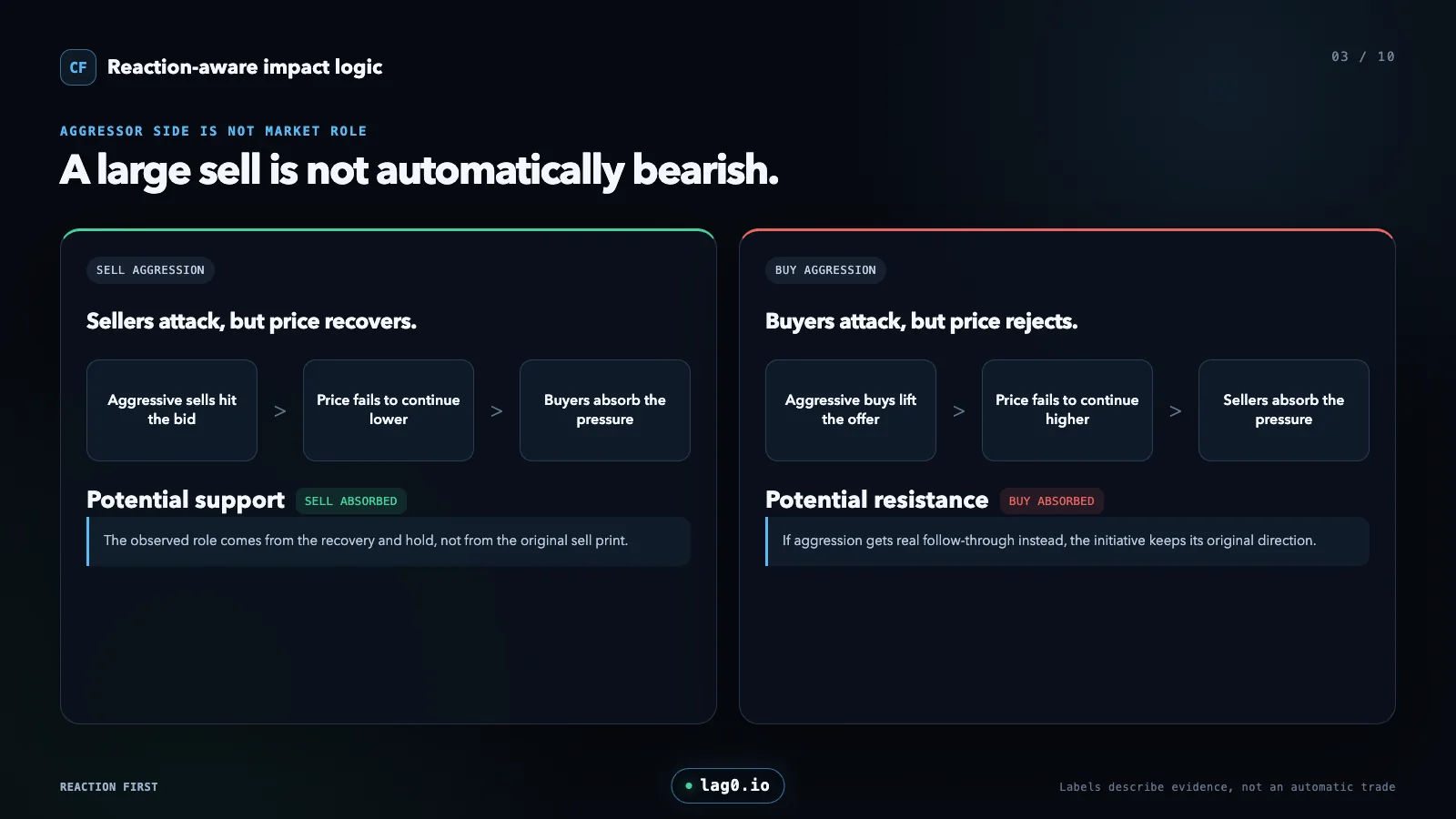
What absorption actually means
Executed volume tells you who crossed the spread. Price response tells you whether that aggression achieved anything.
Absorbed selling
Market sellers repeatedly hit the bid, but price cannot extend lower. If the area then holds or price recovers, passive buyers have accepted the selling. This can create a support candidate even though the initiating print was red.
Absorbed buying
Market buyers repeatedly lift the offer, but price stops moving higher. If price rejects from the area, passive sellers have absorbed the buying. This can create a resistance candidate even though the initiating print was green.
Real continuation
Aggression is confirmed when price keeps moving in the same direction, trades through nearby liquidity and accepts beyond the level. In that case the initiative is working, not being absorbed.
A practical five-step read
A useful absorption read combines location, execution, response, retest and invalidation. Skipping one of those steps creates many false positives.
1. Start with location
Absorption in the middle of random rotation is weaker than absorption at a prior high, volume-profile edge, visible liquidity wall or established impact zone. First ask why this price area should matter.
2. Confirm meaningful aggression
Use the footprint chart, large-trade labels and delta to verify that market orders genuinely attacked the area. One isolated print is less useful than repeated pressure.
3. Measure price efficiency
Compare how much price moved with how much aggressive volume traded. Heavy volume with very little progress is the key contradiction. Heavy volume with clean progress is usually continuation.
4. Wait for reaction or retest
The first stall identifies a candidate, not a guaranteed level. A move away and a later controlled retest give stronger evidence that the opposing side is still defending the zone.
5. Define invalidation
Support is invalidated when price accepts below it; resistance is invalidated when price accepts above it. CryptoFlow tracks this through the impact-zone lifecycle instead of leaving every old reaction on the chart forever.
Read the result, not the color
Red selling followed by recovery can be constructive. Green buying followed by rejection can be restrictive. The aggressor side and the eventual market role are different questions.
Common false signals
Absorption is a market interaction, not a reversal guarantee. These are the failure modes that matter most.
Weak evidence
- A single large trade with no repeated pressure
- A stall caused only by slow activity or a wide spread
- A reaction in the middle of a low-volume range
- A wall that disappears before price reaches it
- A level kept on screen after price accepts through it
Stronger evidence
- Repeated aggression with poor price progress
- Confluence with profile structure or visible liquidity
- A clear move away followed by a controlled retest
- Fresh absorption during the retest
- An explicit nearby invalidation level
FAQ
What is absorption in order flow trading?
It is the failure of aggressive market orders to move price through passive liquidity. The contradiction between high effort and low progress is the useful information.
Is a large sell order automatically bearish?
No. If price quickly recovers and holds after the selling, that pressure may have been absorbed by buyers. Follow-through determines whether the sell was effective.
Does an absorption marker guarantee a reversal?
No. It marks evidence at one location. The level can hold, weaken, break or be reclaimed later, so structure and invalidation remain necessary.
Watch aggression and price response together.
Open CryptoFlow, enable footprint and impact zones, then compare each large print with what price does next.