
1. Start with structure
Check 4h, 1h and 30m direction first. If higher timeframes are pushing down, a bullish 1m footprint often needs absorption or a clear reclaim to mean more than short covering.
A footprint chart matters when you need to know how the move happened, not only where price closed. CryptoFlow shows bid and ask volume per price level so you can see whether a push was actually supported by aggressive execution.
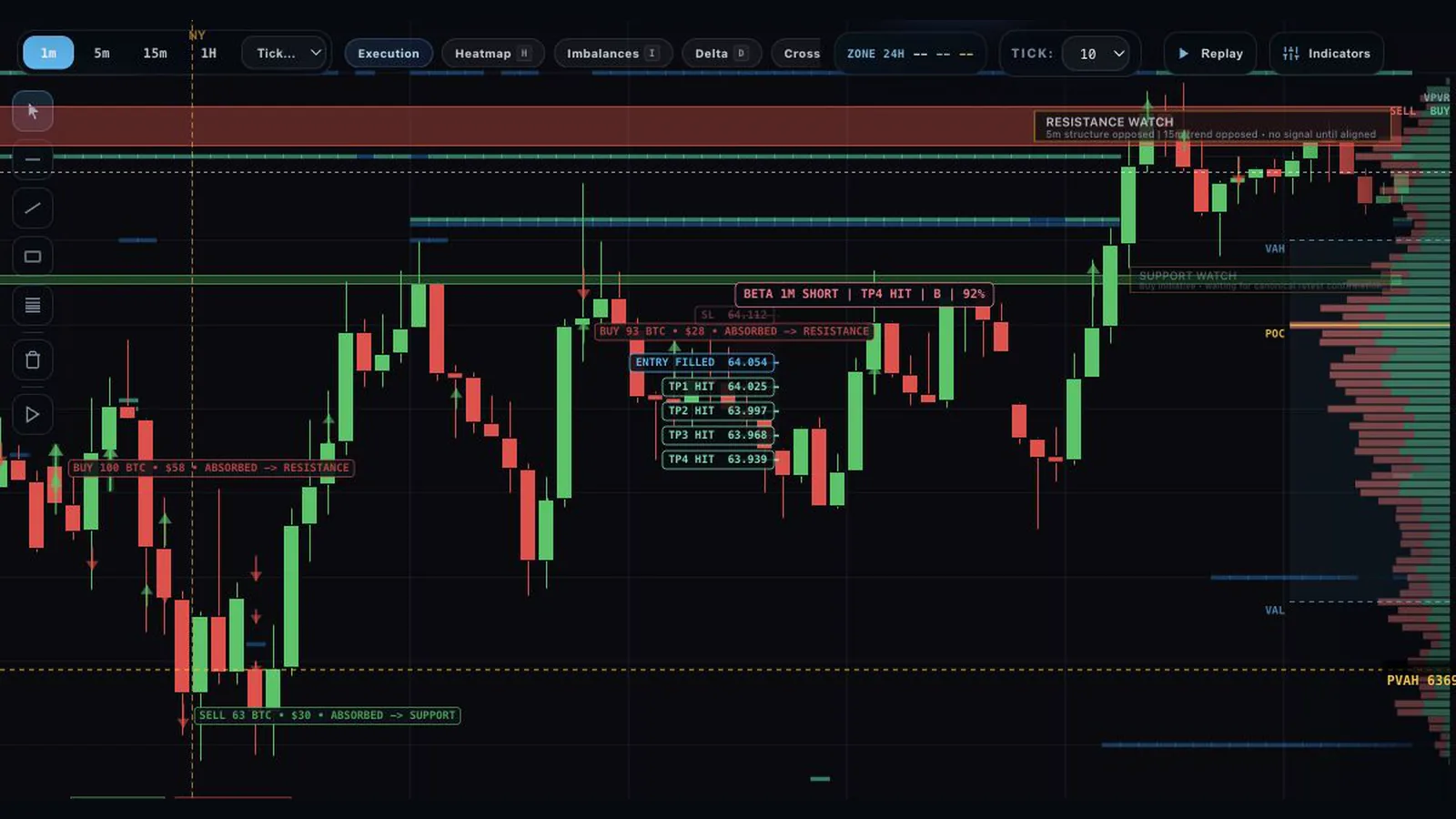
The goal is not to react to every bright cell. The goal is to compare execution against location: session levels, volume profile, heatmap liquidity and the higher-timeframe move.
Check 4h, 1h and 30m direction first. If higher timeframes are pushing down, a bullish 1m footprint often needs absorption or a clear reclaim to mean more than short covering.
If price rises but ask-side aggression is weak, the move is thin. If price stalls while buy-side cells remain heavy, you may be looking at absorption rather than momentum.
Multiple adjacent imbalance levels are more meaningful than one isolated number. They show that execution pressure repeated through the move instead of appearing once by chance.
Most footprint mistakes come from reading cells in isolation. The chart is strongest when you tie it to location and recent pace.
The same bright footprint candle can mean opposite things depending on what happens next. Two short scenarios make the difference concrete.
Price breaks a 1h level with stacked ask-side imbalance, and the next candles keep printing fresh buy aggression at higher prices. Delta stays positive, the heatmap above shows thin resting supply, and there is no large passive wall soaking the bids. Here the footprint is confirming the move: aggressive execution is being rewarded with continuation rather than getting trapped.
Price reaches the same level with heavy buy-side cells, but it stops advancing. Buy volume keeps stacking while the candle highs barely move — a sign that a passive seller is filling every market buy without giving ground. On the heatmap a large ask wall stays put through the test. This is absorption: the aggression is real, but it is being absorbed, and a failed continuation often follows.
Always ask whether aggressive execution is moving price or being eaten. A footprint candle is bullish only if buyers keep getting filled at progressively higher prices. The moment heavy buying stops lifting the offer, the same green cells become evidence of a trap rather than strength.
Tick size is the single setting that most changes how a Bitcoin footprint reads. It controls how many price levels are merged into each cell, so the wrong choice can hide the detail you came for — or invent clarity that is not there.
For intraday BTC, the footprint is most useful when anchored by a higher timeframe. CryptoFlow typically reads 4h and 1h first, then drills into 30m, 5m and 1m for execution detail.
No. It shows how the move traded, not whether the trade is automatically good. Passive liquidity, structure and pace still matter.
The AI summarizes multi-timeframe context and the recent order-flow picture. It is useful as a second read, not as an autopilot.
Use the app, adjust the tick size first, then compare executed pressure with the heatmap and DOM.