
1. Map the wall
Note the level and whether it is isolated or part of a larger stacked area. One bright band can matter less than a broad zone that keeps rebuilding.
A heatmap shows where liquidity was resting. The DOM shows the current ladder around price. Both are useful only if you compare them with executed trades, spread behavior and the actual reaction when price reaches the level.
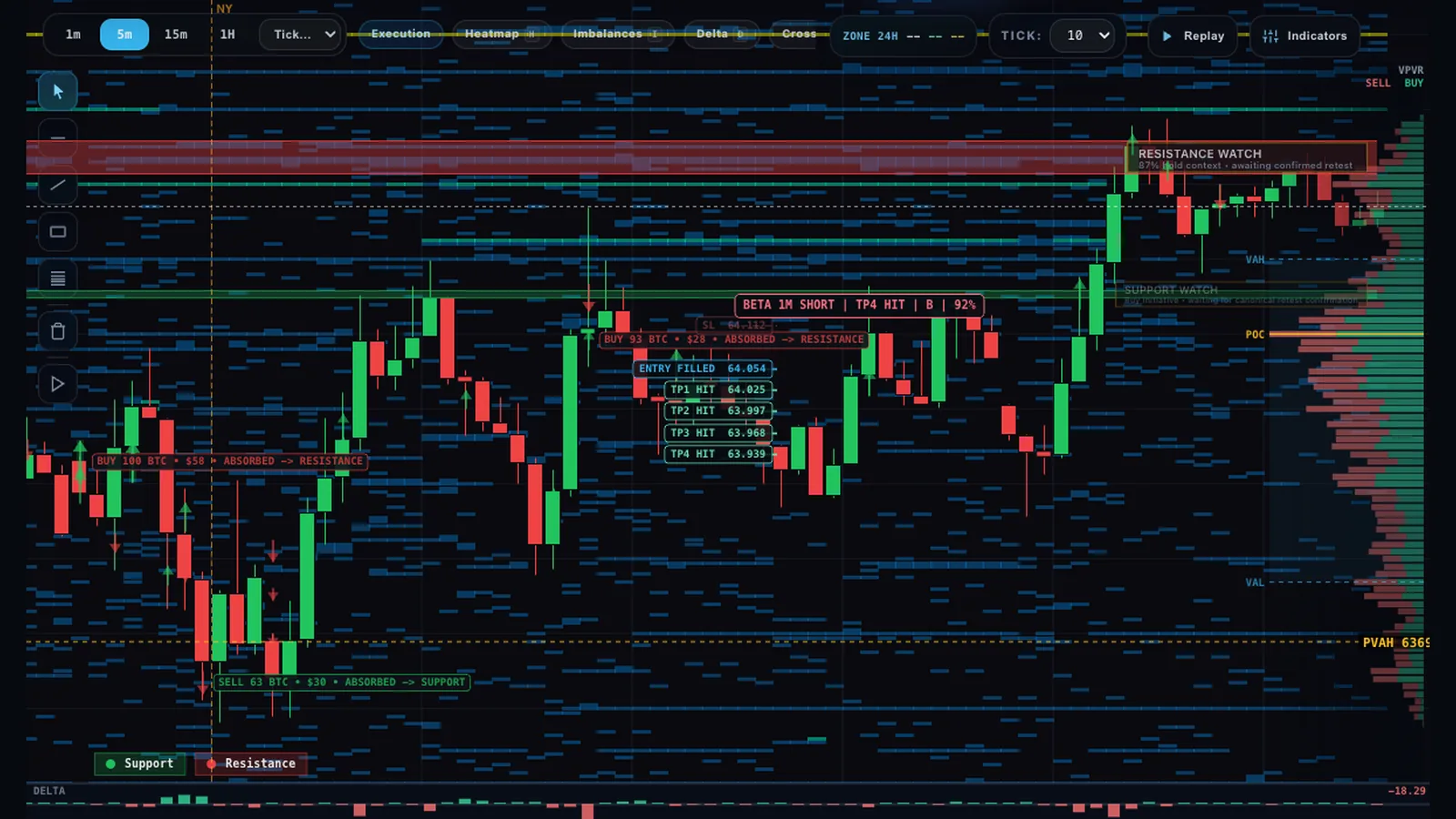
The main mistake is treating every bright wall as a guaranteed reversal. A wall that gets pulled, stepped through or absorbed is not support or resistance in any reliable sense.
Note the level and whether it is isolated or part of a larger stacked area. One bright band can matter less than a broad zone that keeps rebuilding.
Price reaction is the key. If price touches the wall and aggressive flow fails to continue through it, the level becomes useful. If price cuts through cleanly, the wall was mostly noise.
The ladder helps you inspect the local spread and nearby book shape. It is strongest for immediate context, not for long-horizon prediction on its own.
In production, the heatmap and DOM are designed to support the footprint view, not replace it. Use them to understand why a move stalled or accelerated.
A liquidity heatmap is only as honest as the orders behind it. In crypto perps, a large share of displayed size never intends to trade — which is exactly why reaction beats appearance.
A wall that vanishes the moment price approaches was never real support. On the heatmap you will see a bright band fade out just before the test. Treat these as traps for breakout traders, not levels — the absence of a fight is the signal.
The opposite is more telling: size that keeps rebuilding as it gets eaten. Each time market orders chew through the level, fresh liquidity reappears at the same price. That persistence through real execution is what turns a wall into a level worth respecting.
Pair the heatmap with executed volume. If a wall holds and aggressive flow into it stalls, you have absorption. If price slices through while the wall sits untouched, the displayed size was decoration. The chart's footprint and big-trade markers give you that confirmation in one view.
The heatmap shows resting liquidity. The footprint shows executed trades. One is intent or displayed supply/demand; the other is what actually traded.
Yes. It can be pulled before the touch or refreshed in a way that changes the story. That is why reaction matters more than the wall’s first appearance.
Only for quick context. On smaller screens it is better to rely on the chart first and use the DOM as a narrow confirmation tool.
Use the heatmap and DOM to qualify the move, not to predict it in isolation.